Indonesian furniture: how to buy factory-direct and what to check
To buy furniture factory-direct from Indonesia, check that the workshop is the supplier's own, that the timber comes with legality documents (the SVLK system and the V-Legal document, required for exports since 2013), that you approve a drawing and sample before production, and who pays and is responsible at each stage of shipping and customs.
Why buy teak furniture from Java?
Because the timber, the workshops that work it and a national system that documents the legality of exported timber all come together there. For a European buyer, all three matter.
Searches for Indonesian furniture lead mainly to two places. Central Java is where the manufacturers are, such as those around Jepara. Agents based in Bali also show up in the results, buying from different workshops and offering volume discounts.
Teak is widely grown on plantations across tropical Asia, Africa and Latin America, according to The Wood Database. Origin matters: the same source notes that Myanmar teak has been under sanctions since 2021. Always ask where the timber comes from, Indonesian manufacturers included, because one workshop may use timber from more than one origin.
What teak brings as a material, and how to look after it, is covered on the teak page.
Factory, agent or shop: who are you buying from?
From whoever makes it, if you can. An agent or wholesaler can be useful, but puts a middleman between you and the workshop, and with it one more question every time something changes.
| How you buy | Who makes it | In its favour | What to watch |
|---|---|---|---|
| Factory-direct | The company selling to you | You deal with whoever makes the piece, with no middleman's margin | Distance, language and time zone; that the workshop is its own, not subcontracted |
| Factory with a team in Europe | The company selling to you | Factory pricing, with a contact in your language and time zone | That the European team can resolve problems, not just sell |
| Agent in Indonesia | Several workshops chosen by the agent | Brings together pieces from different workshops and negotiates on volume | Which workshop makes each piece, and who answers if it goes wrong |
| Shop or wholesaler in Europe | Often not stated | Stock close by and a simple purchase | Little customisation; ask about the timber's origin and documents |
One simple test, however you buy: ask for photos or a video call from the workshop while your order is in production, not catalogue shots.
What should you check in an Indonesian manufacturer?
That it makes what it sells, that it documents the timber and that it puts what it agrees in writing. Almost everything else follows from those three.
- Its own workshop. Ask how many factories it has, where they are and whether it subcontracts any stage, such as upholstery or finishing.
- Timber origin and legality: where it comes from and which documents travel with it on export.
- Certificates you can check. If it claims FSC, ask for the certificate code and look it up in FSC's public database.
- Tests for contract use. For hotel or restaurant seating, ask for tests to EN 16139; for outdoor pieces, to EN 581. The guide to contract furniture explains what else to ask for.
- A technical drawing and a sample before production, both approved by you in writing.
- A complete quote: price per piece, finishes, lead time, packing and delivery terms.
- Payments tied to clear milestones, such as sample approval or the goods leaving the factory.
- References from projects like yours, with a contact you can call.
Be wary of vague answers on any of these points. A manufacturer with its own workshop can show it and document it.
How do you know the timber is legal?
By asking for the export documents and, under the EUDR, the information your own company needs for its due diligence. Indonesia has a national timber legality system, SVLK, which issues those documents.
- According to Indonesia's Ministry of Forestry, exports of timber products have required a V-Legal document since 1 January 2013.
- According to Preferred by Nature, Indonesia has issued FLEGT licences for timber exported to the EU since 15 November 2016.
- The EU Deforestation Regulation (EUDR) applies to large and medium-sized companies from 30 December 2026, and to micro and small ones from 30 June 2027. The European Commission lists furniture among the products covered.
- An FSC certificate does not on its own exempt you from EUDR obligations, as FSC Spain points out.
How SVLK, FLEGT and FSC fit with the EUDR, and exactly what to ask the supplier for, is explained in the guide to EUDR, SVLK and FSC.
Which samples should you ask for before a large order?
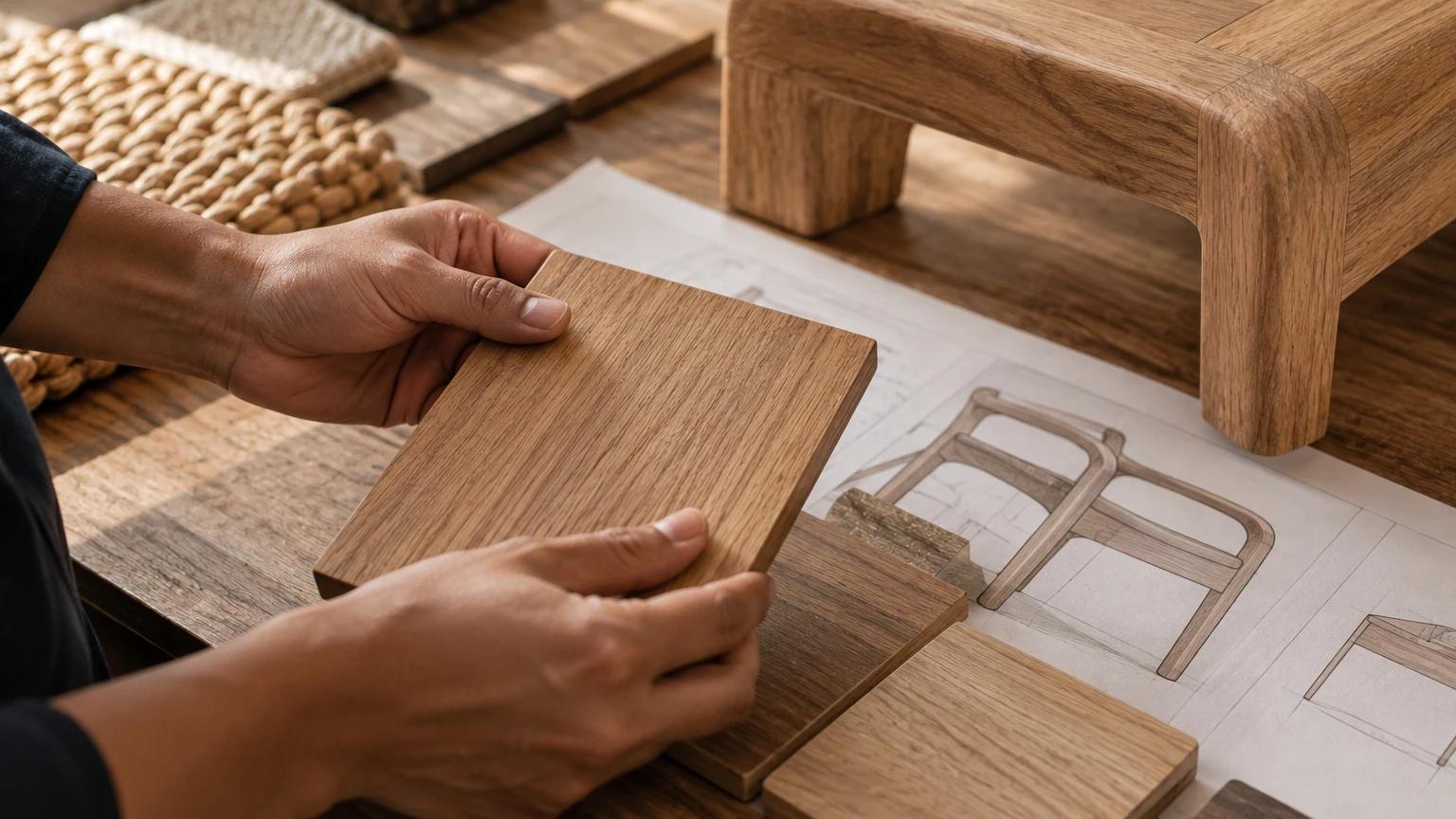
A sample of each timber finish and each fabric, and one complete piece of the model you will repeat most. The approved sample is the benchmark production is measured against.
- Finish: a piece of the same timber with the final finish, to see it under the light of the space.
- Piece: one complete unit to sit on, move about and check for joints, sanding and stability.
- Fabric: the colour and composition, with its fire test report if the project requires one.
Sign and date the approval, and keep photos. If production drifts from the sample, that is your evidence. A sample takes time, but it costs less than a hundred chairs that are not what you expected.
The full sequence of drawing, sample, production and delivery is set out in the guide to bespoke furniture from Java.
How does an order from Indonesia reach Europe?
In stages: packing and dispatch at origin, international transport, customs in the EU and delivery to site. Each stage has a cost and someone responsible for it, and whatever is not written down will end in an argument.
Delivery terms are set with an Incoterm, the trade rule that says at which point costs and risk pass from seller to buyer. It should appear on the quote and the invoice, together with the exact place it refers to.
On entering the EU, the goods clear customs. They are declared under their tariff code (9401 for seating, 9403 for other furniture), which sets the duty that applies, and pay import VAT. Check the current rate for your code in TARIC, the EU tariff database. Ask who handles clearance and who is named as importer, because each role carries different obligations.
Get these in writing before you pay:
- The Incoterm and the place of delivery.
- Cargo insurance in transit: who takes it out and what it covers.
- Customs clearance: who handles it and who is the importer.
- Packing: how each piece is protected and how the boxes are labelled.
- Final delivery: to the door, inside the building or placed in position.
What are the risks of buying so far away, and how do you reduce them?
The risks come from distance: you do not see the pieces until they arrive, you work in another language and time zone, and if something goes wrong, it is thousands of kilometres away. A contact in Europe does not remove the distance, but it shortens each of those gaps.
| Risk | How to reduce it |
|---|---|
| Not seeing the piece before paying | A sample approved before production, and finishes seen in a showroom in Europe |
| Misunderstood dimensions or finishes | A technical drawing approved in writing, and a contact who speaks your language |
| Production that differs from the sample | Photos or a video call during production, and a check before packing |
| Damage in transit | Agreed packing, insurance and a check on arrival, with any damage noted on the delivery note |
| Timber without legality documents | Export documents with every shipment, and the information your due diligence needs |
| Nobody answers when there is a problem | A named person who follows the order and handles any issues |
This is how Kadek works: it makes its furniture in its own six factories in Central Java, and has a sales team and a showroom in Madrid, in Pinto, open by appointment on weekdays, free of charge. One person in Madrid follows each order until delivery to site. Before you confirm an order, ask in writing which timber legality documents will travel with it.
Frequently asked questions
Is there a minimum order when buying from an Indonesian factory?
It depends on the manufacturer, so ask before you request a quote. Kadek has no minimum order, new pieces included.
Is Balinese furniture the same as furniture from Java?
Not necessarily. "Balinese furniture" usually names a style, and what matters is where the piece was made and where the timber came from. Ask about the workshop and the origin.
Can I visit the factory in Indonesia?
Ask: a manufacturer with its own workshop can show it to you. If the trip is not worth it, ask for a video call walking through the workshop and photos of your order in production.
Is it cheaper to buy direct from the factory?
Usually, on the price of the piece, because there is no middleman's margin. Always compare the final cost, with shipping, customs, taxes and delivery included.
How long does an order from Indonesia take?
It depends on the pieces, the quantities and the shipping, and a reliable lead time only comes with the quote. Ask for production and shipping to be shown separately, so you know which part depends on whom.
Which documents should you keep for each order?
The quote and invoice, the approved drawing and sample, the packing list, the timber legality documents and any test reports. You will need them to make a claim, replace pieces or show where the timber came from.
Sources
- Indonesian Ministry of Forestry, Indonesian Legal Wood (SVLK and V-Legal)kehutanan.go.id
- Preferred by Nature, FLEGT licensing in Indonesiapreferredbynature.org
- European Commission, Regulation on deforestation-free productsenvironment.ec.europa.eu
- FSC Spain, the EUDR and the role of FSC (Spanish)es.fsc.org
- The Wood Database, Teakwood-database.com