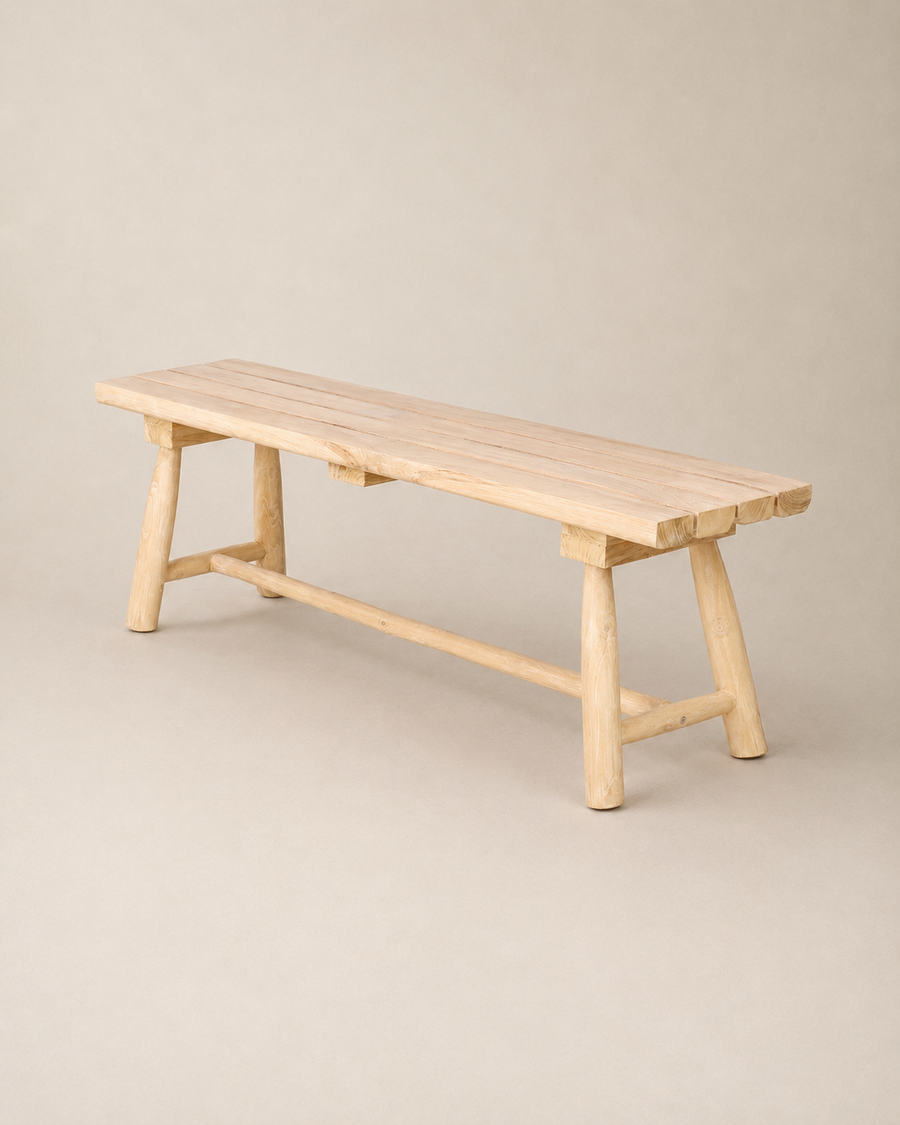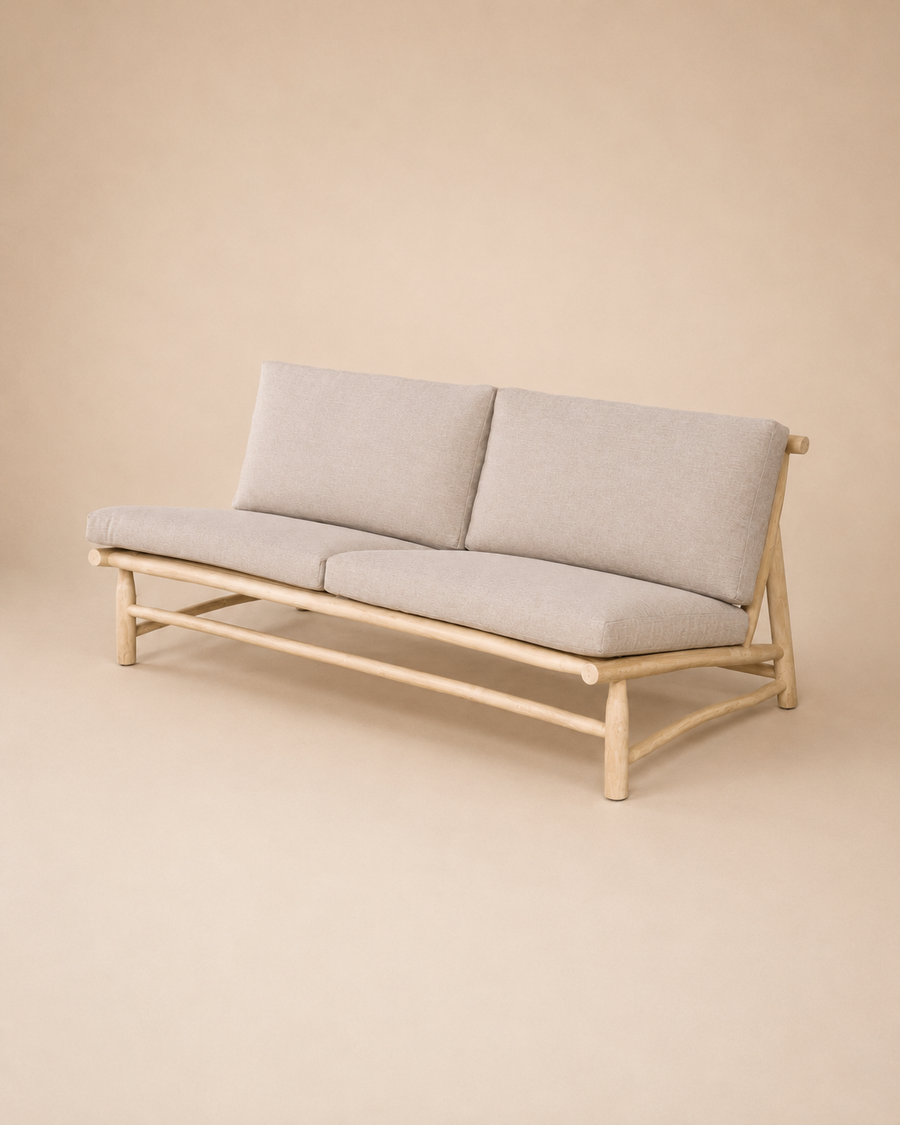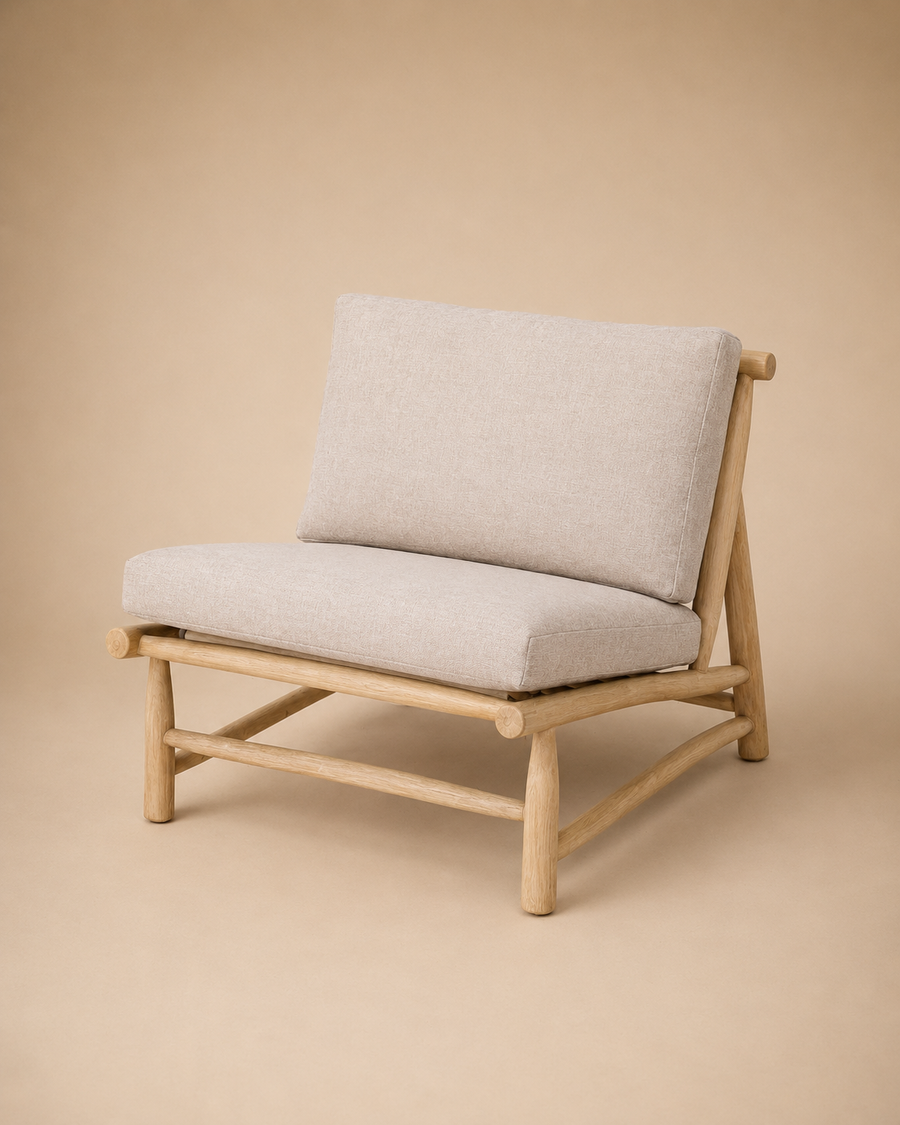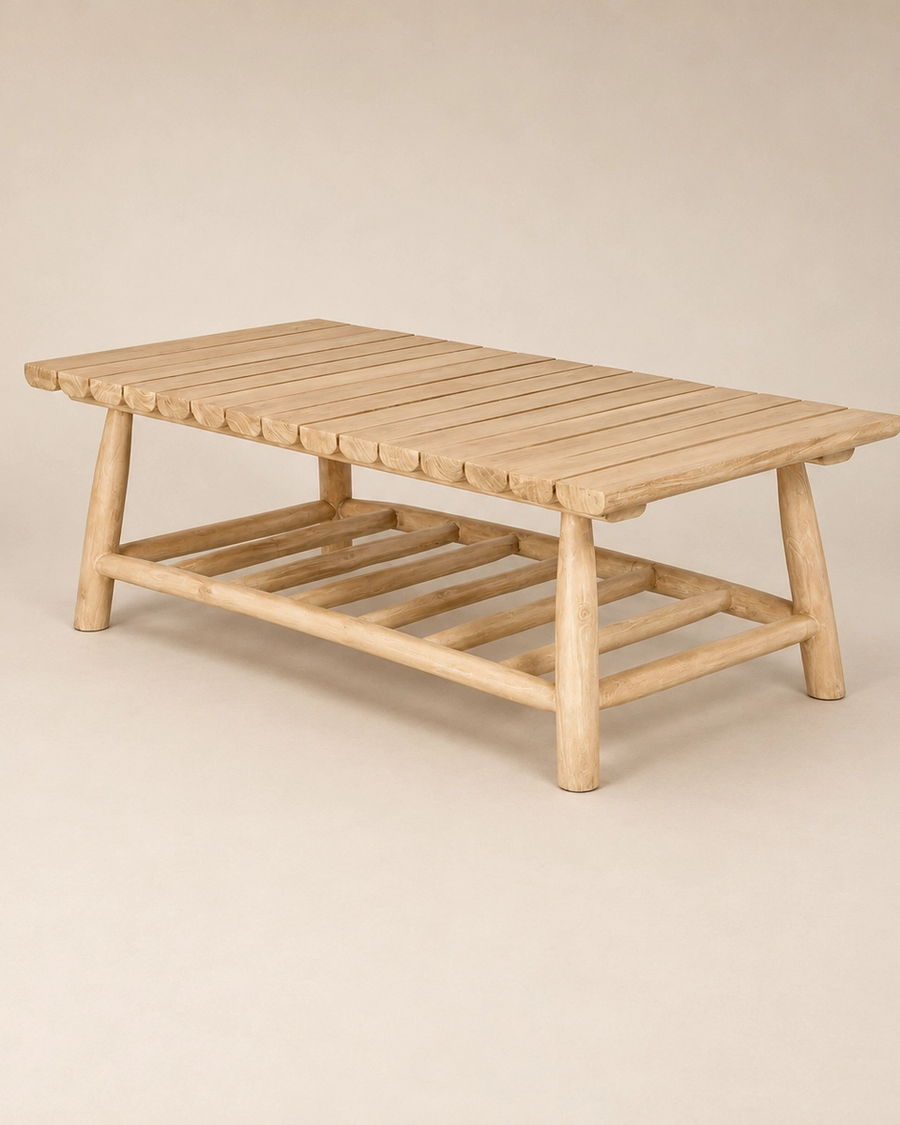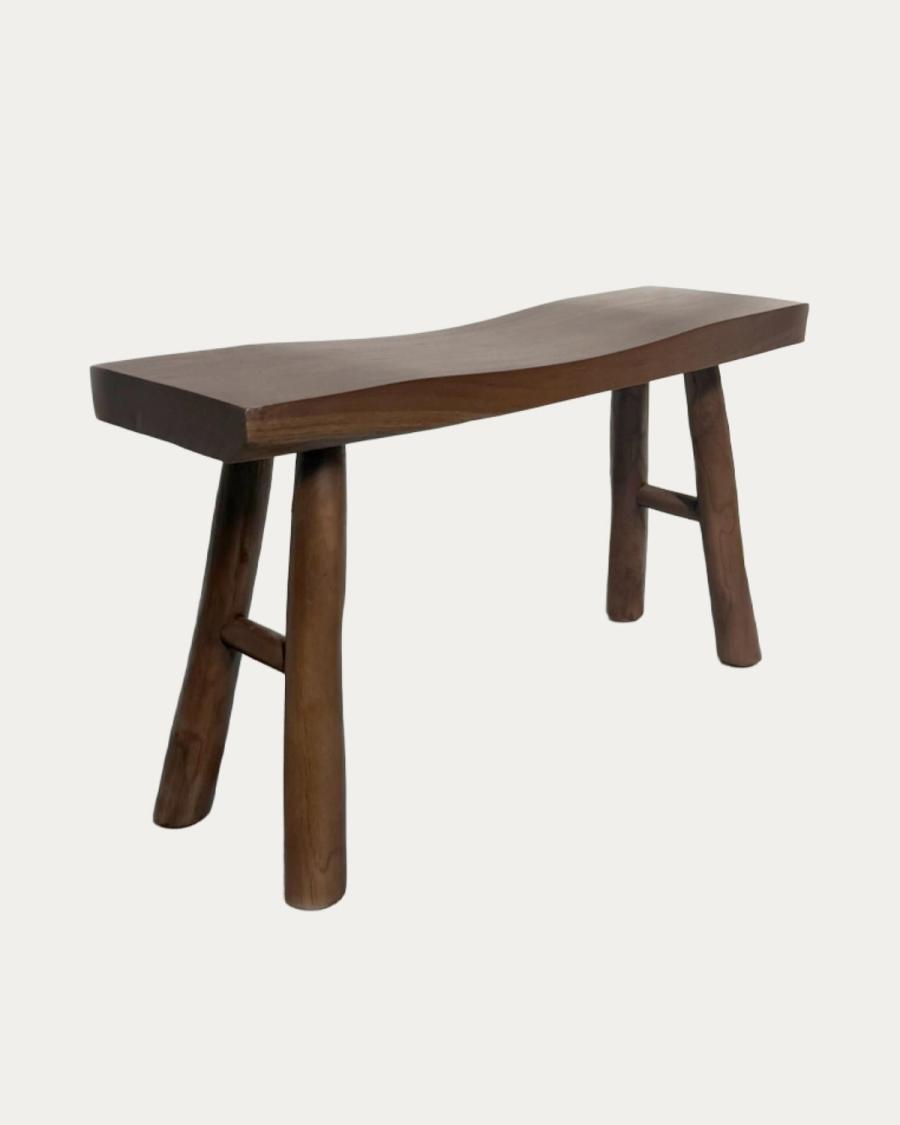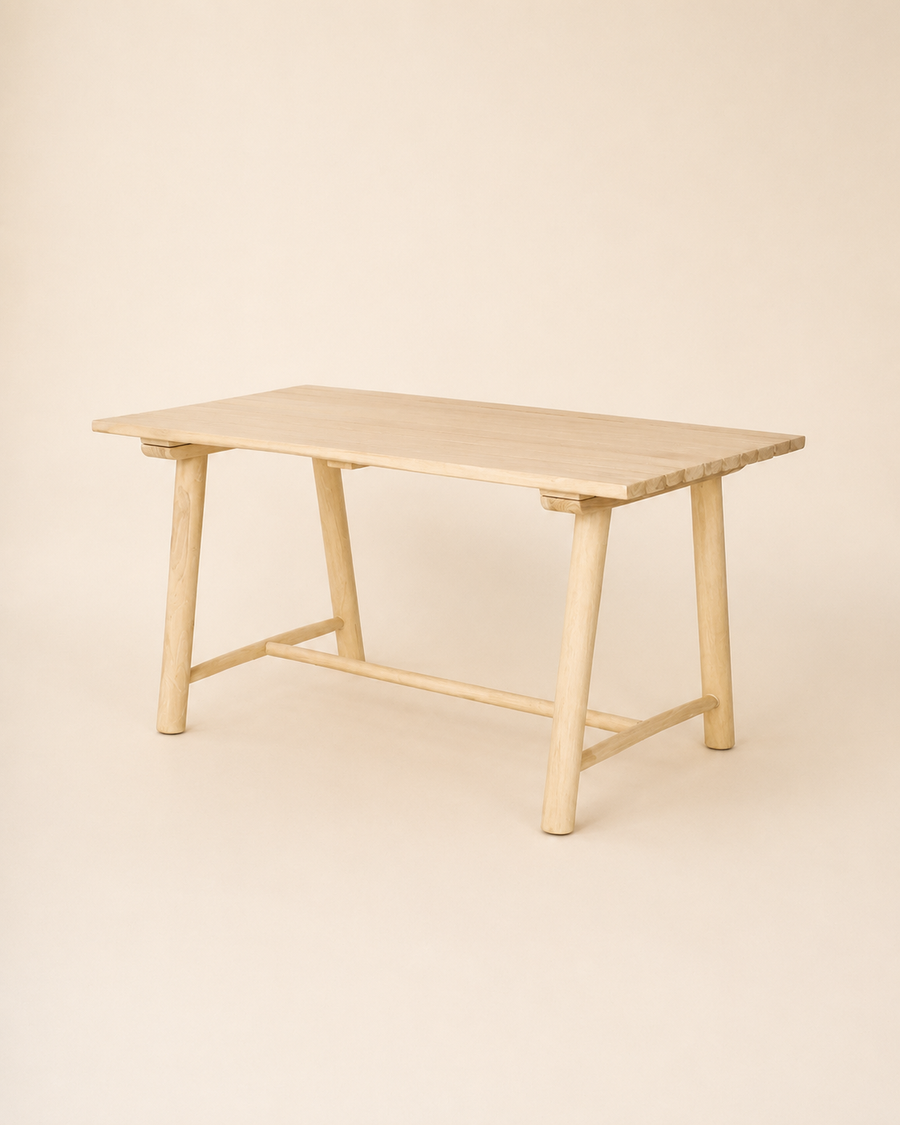
PendopoDining table
Teak branch, iron
For outdoor furniture left untreated, teak and iroko are the most reliable woods: their heartwood is rated durability class 1 to 2 against fungi, or 1 to 3 for plantation teak depending on origin. Plantation acacia and Scots pine sit at class 3 to 4 and need treatment, a maintained finish or a roof overhead.
Teak and iroko are the most reliable woods for furniture that spends the year in sun and rain without treatment. Both have heartwood that strongly resists decay, and both move little as humidity changes.
Acacia and pine turn up in garden furniture too, but their heartwood is far less durable. They work outside only when treated, kept under a finish that is renewed, or placed under cover. In hospitality, where a chair is used every day and nobody brings it in when it rains, that gap matters more than it does at home.
Unless another source is named, the figures here come from Tropix, the timber data sheets published by CIRAD and the International Tropical Timber Organization.
It is the wood's natural resistance to decay fungi, on the EN 350 scale from 1 (very durable) to 5 (not durable). The class describes the heartwood only: the darker inner part of the trunk.
Sapwood, the paler outer layer, sits outside that rating and is where trouble starts. In teak it is 2 to 6 cm thick and clearly marked off from the heartwood, so it can be cut away. An outdoor piece that includes sapwood will not last as long, however good the species.
The data sheets also give the use class the untreated heartwood covers, meaning the exposure it can take on its own:
One caveat on teak: almost all teak sold today is plantation-grown, and its durability ranges from class 1 to 3 depending on the age and origin of the trees. CIRAD notes that some mature plantation teak from Indonesia and Costa Rica matches the durability of natural-forest teak. So ask about origin and age, not just species.
Teak pairs high durability with very little movement; iroko comes close; acacia and pine need protecting. The table sets out the data, with oak and ipe for reference.
| Wood | Durability against fungi | Use class untreated | Specific gravity | Tangential shrinkage |
|---|---|---|---|---|
| Teak | 1 to 3, by origin and age | 3 to 4, by origin | 0.67 | 4.7% |
| Iroko | 1 to 2 | 3 | 0.64 | 5.4% |
| European oak | 2 | 3 | 0.74 | 9.7% |
| Acacia mangium | 3 to 4 | 2 | 0.52 | 7.0% |
| Scots pine | 3 to 4 | 3, heartwood only and well drained | 0.55 | 8.3% |
| Ipe | 1 | 4 | 1.04 | 6.4% |
Tangential shrinkage measures how much the wood shrinks as it dries. The lower it is, the less joints open and the fewer cracks appear as humidity swings between winter and summer.
Teak is the benchmark for stability: it shrinks least of any wood in the table. It holds natural oils, which make it feel oily and help it shed water, and up to 1.4% silica, according to The Wood Database. In the sun it turns silver-grey within months without losing strength, as our teak care page explains.
An African hardwood close to teak in durability. Its interlocked grain can tear out when planed, and it sometimes carries hard deposits of calcium carbonate. It also contains chlorophorin, an antioxidant that slows the drying of oils, so some finishes take poorly. CIRAD rates it fit for outdoor use untreated, provided the piece drains well and has no water traps.
“Acacia” is a trade name covering many species, so ask which one you are buying. Taking plantation Acacia mangium as the reference, its heartwood is class 3 to 4, vulnerable to insects and termites, and untreated covers only use class 2. Outdoors it needs treatment and a finish that is kept up; UK suppliers usually advise oiling it every year.
Scots pine has a wide band of sapwood, 5 to 10 cm, that takes up preservatives readily. That is why outdoor pine is sold pressure-treated, often to use class 4. It is still a soft wood (Monnin hardness 2.6 against teak's 4.2), so it dents easily and moves more.
None lasts forever, but ipe heartwood, and teak depending on origin, will stand ground contact and fresh water (use class 4). Teak and iroko also resist sea water; in teak's case thanks to its high silica content. That is why teak is the traditional timber for boat decks.
In furniture, rot rarely starts with the species and almost always with the design: legs standing in puddles, joints that hold water, sapwood left in. In the same wood, a chair whose joints drain and whose feet stay out of standing water outlasts one that traps moisture by a long way.
It depends on the wood. Teak and iroko need nothing to last; pine and acacia need treatment and a finish that is maintained.
There is no reliable single figure: it depends on the species, on whether the piece is heartwood, on the design and on the use. The figures in circulation come from sellers. UK teak retailers quote 25 to 50+ years, and the maker Barlow Tyrie goes as far as 70 in a sponsored feature in Gardens Illustrated. Spanish contract supplier Sinergia Contract cites up to 50 years for shorea and over 25 for ipe.
Treat them as a guide, not a guarantee. In hospitality, wear tends to come from use before weather: dragging, stacking, knocks from trolleys. A solid chair with sound joints can be sanded, repaired and kept in service for years.
For an exposed terrace, teak or iroko heartwood; in covered areas and indoors, the choice widens. What decides it is how much direct rain and sun the piece gets, and how much upkeep the team can take on.
Rule of thumb: if the piece will sit in sun and rain with no cover, ask for class 1 or 2 heartwood and a design that sheds water. Under a roof, the finish matters more than the species.
Kadek Living makes its outdoor furniture in solid teak. Ask any supplier, us included, which plantation the teak comes from and whether outdoor pieces are heartwood only. To see how teak looks with and without oil, you can compare finishes at the Madrid showroom.
For durability alone, ipe: class 1 and fit even for ground contact. But its specific gravity is 1.04, about 55% higher than teak, which makes it heavy for chairs moved every day. For hospitality furniture, teak strikes a better balance of durability, stability and weight.
It usually costs more than other woods, and its silica blunts tools, which adds to the cost of working it. It turns grey unless oiled. And teak from Myanmar has been under sanctions since the 2021 military takeover, according to The Wood Database, so it pays to know where yours comes from.
It is not listed by CITES, but the IUCN Red List rates *Milicia excelsa* as near threatened and *Milicia regia* as vulnerable, according to The Wood Database. If you choose iroko, ask for its origin and legality paperwork.
In the EU, the deforestation-free products regulation (EUDR) covers furniture and applies to large and medium operators from 30 December 2026. Our guide to EUDR, SVLK and FSC explains how it works for teak.
Yes. A durable, stable wood performs just as well inside, and indoors it does not turn grey because it gets no direct sun or rain. The reverse does not hold: an indoor wood will not last outside without protection.