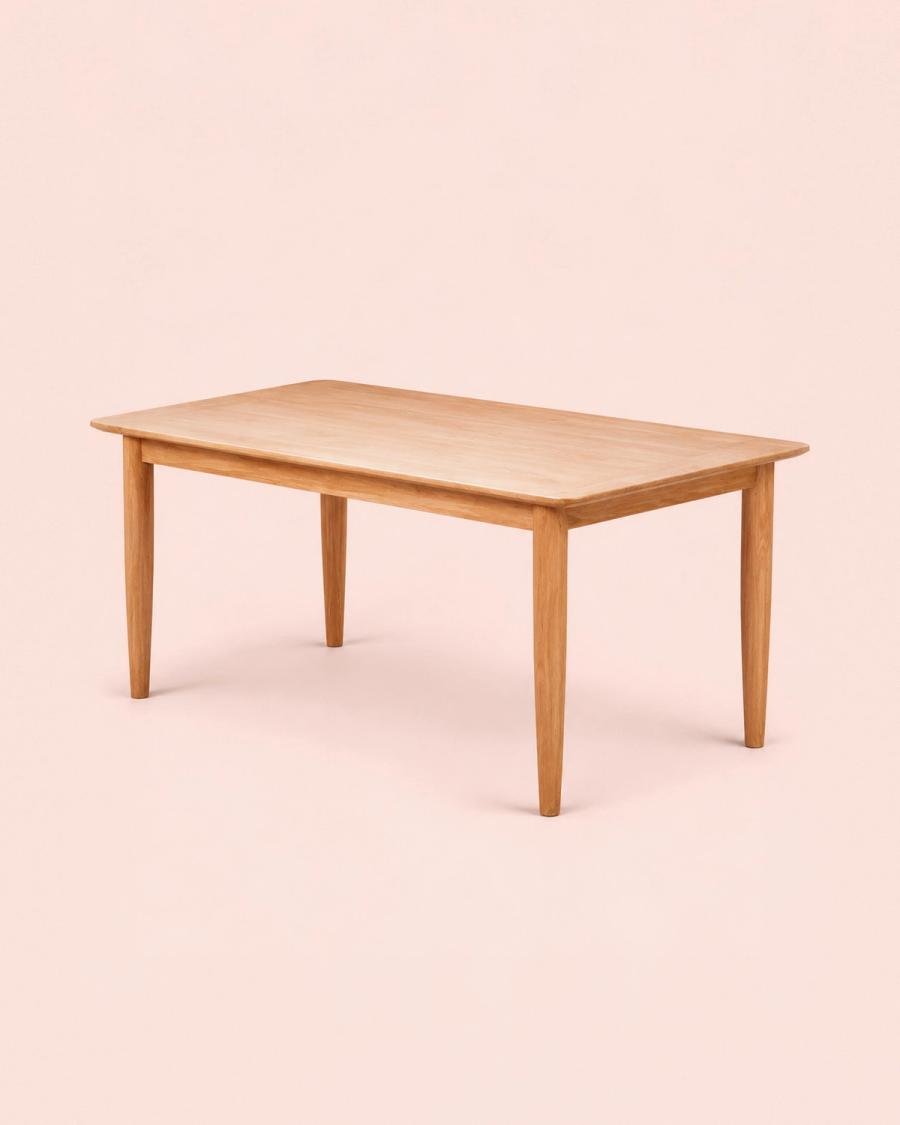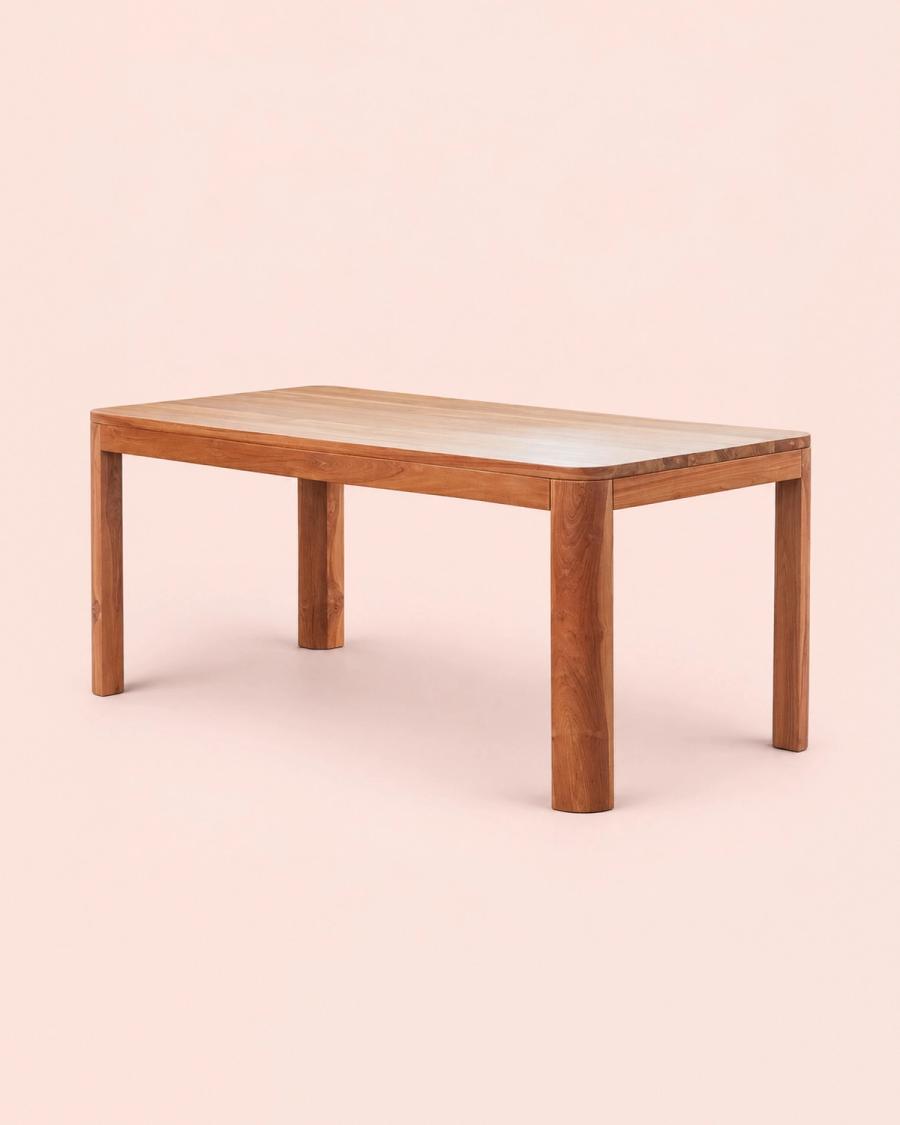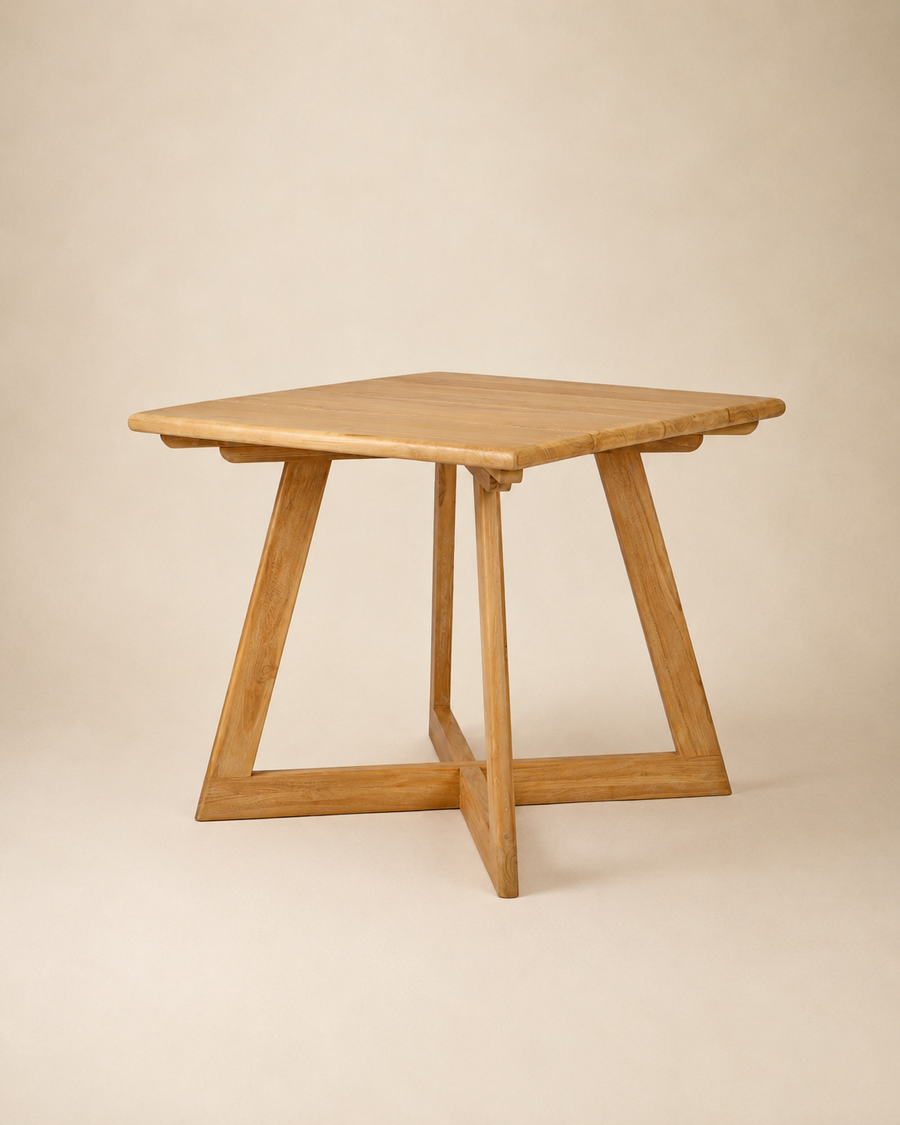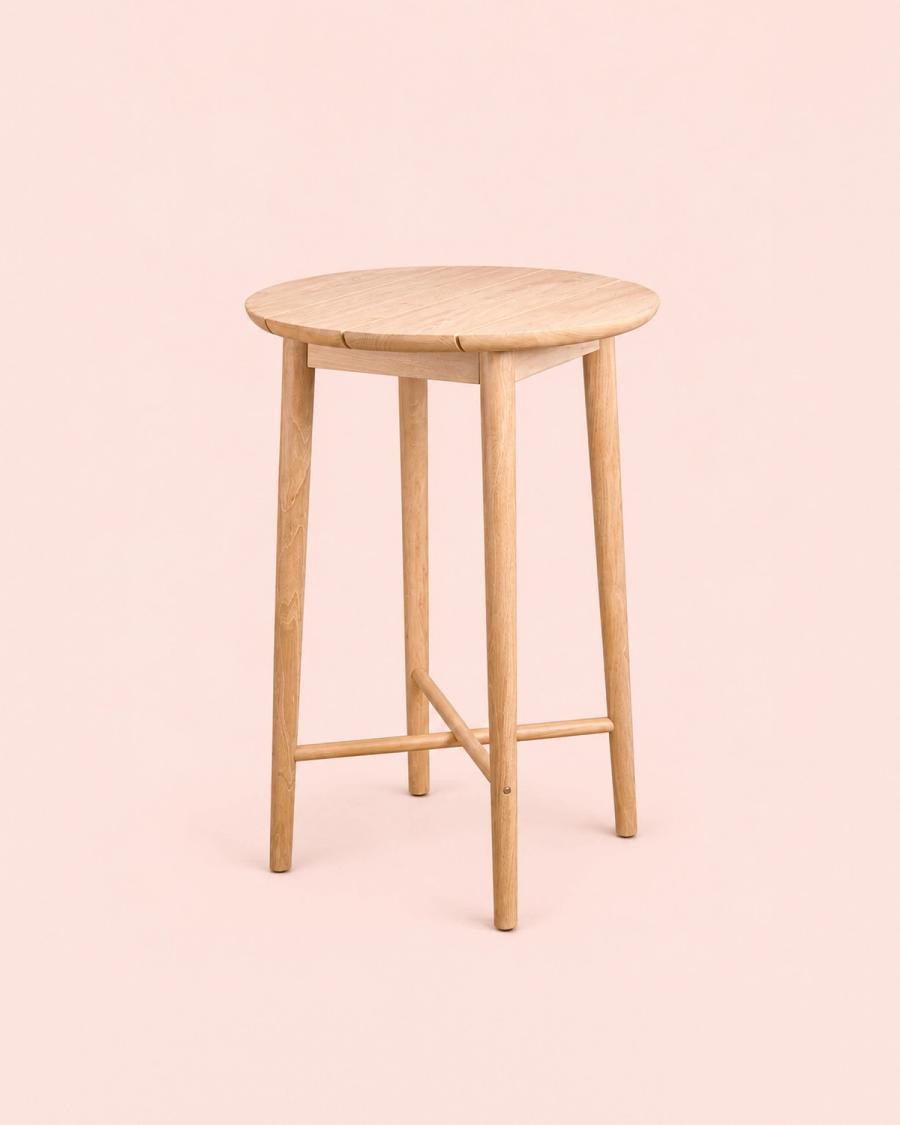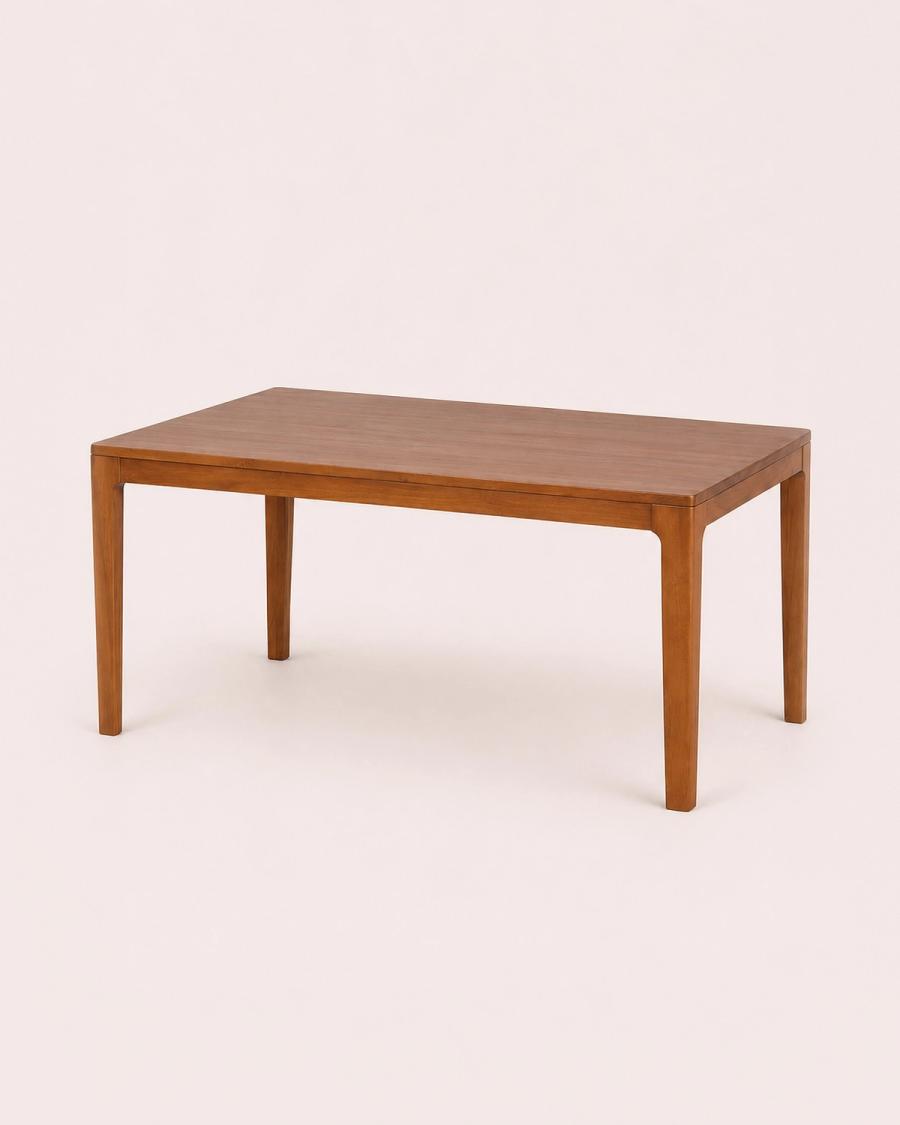
RimbaDining table
Teak
Teak is expensive because it takes decades to grow, because its durability lies in the heartwood rather than the whole trunk, and because its silica blunts tools. On Java's state plantations the felling cycle runs from 40 to 80 years. Grades A, B and C are a trade convention, not a standard.
Because four things add up: the tree takes decades to yield usable timber, only part of the trunk has the durability you are paying for, it is a demanding wood to machine, and demand outstrips supply. None of them depends on the furniture brand.
The Wood Database puts it plainly: despite being grown on plantations around the world, teak is still very expensive, perhaps one of the most expensive timbers on the market in large, unfigured sizes. Sinergia Contract, in its guide to hospitality materials, puts the rising price down to high demand and limited availability.
Which papers to ask for, and how to check them, is covered in the guide to EUDR, SVLK and FSC.
Old-growth teak comes from slow-growing wild trees, mainly in Myanmar; plantation teak is grown on managed land. With Myanmar teak under sanctions, the practical question today is which plantation the timber comes from, and with what paperwork.
The trade uses Burmese teak for wild-grown trees from Myanmar, to set it apart from plantation teak. The Wood Database notes one visible difference: faster-grown plantation wood tends to be semi-ring-porous, while slower-grown wild wood is more distinctly ring-porous. The same source does not compare their strength or stability, so be wary of anyone who claims a difference without data.
After the military takeover in Myanmar in February 2021, sanctions were placed on imported Myanmar teak, as The Wood Database records, linking the trade to human-rights abuses. For a European buyer, that moves the conversation to plantations.
On Java, teak in the state forests is managed by the state-owned company Perum Perhutani. According to a paper by the company itself, published by the FAO, it manages more than a million hectares of teak plantation, on felling cycles of 40 to 80 years depending on the site and on social factors. That long cycle explains much of the price: the tree ties up land and labour for decades before it yields any timber.
They are a trade way of describing which part of the trunk was used, not a class set by any standard. Each seller applies them in its own way, so grade A on one website does not promise the same as on another.
Definitions vary, but most agree on the basics:
| Grade | Part of the trunk | Usual look | What it means |
|---|---|---|---|
| A | Heartwood from mature trees | Even honey or mid-brown colour, regular grain | The durability expected of teak |
| B | Outer heartwood, or a mix with some sapwood, depending on the seller | Less even colour | Less predictable outdoors |
| C | A lot of sapwood | Pale areas, more knots and defects | Does not behave like heartwood teak |
Since the grade is not standardised, it is more useful to ask about what lies behind it:
A sample tells you more than any letter. Kadek sends a technical drawing and a sample of the piece or the finish for approval before production, and finished pieces can be seen at the showroom in Madrid. Ask too, in writing, which plantation the timber comes from and how much heartwood the visible faces carry.
Mostly because of how much timber goes into it and how much work. Two teak chairs can look alike in a photo and have nothing in common in the thickness of their parts, their joints or their finish.
| Factor | What makes it cost more | Why it matters in hospitality |
|---|---|---|
| Amount of timber | Thick sections and solid tops | More rigidity under daily use |
| Timber quality | Heartwood only, no sapwood on visible faces | The piece behaves the same across its whole surface |
| Joints | Glued mortise-and-tenon joints rather than screws alone | Durability tests check that they do not work loose |
| Drying | Timber properly dried before it is worked | Less movement and fewer cracks later |
| Handwork | Woven rope, rattan, rounded edges, fine sanding | Hours in the workshop per piece |
| Upholstery | Technical fabrics and fillings | Adds cost, and is replaced before the timber |
| Finish | Oil or stain applied at the factory | Mainly changes the look |
| Shipping volume | Bulky pieces, or pieces that do not stack | They take up more room in the container |
That is why comparing the price of two teak pieces without comparing these points is misleading. A cheaper chair may use less timber, more sapwood or simpler joints, and the difference shows years later, when the hotel is already using it every day.
It depends so much on origin, log diameter, quality and drying that a figure without context is no use for comparison. That is why this guide gives no price per cubic metre: it changes with every batch and every market.
Besides, the price of raw timber says little about the price of a piece of furniture. Between the log and the finished piece, timber is lost in sawing, in drying and in separating heartwood from sapwood, and then come workshop hours, finishing, packing and freight. A tabletop sold by the piece and a plank sold by the cubic metre are different products.
If you need a benchmark, ask for quotes against the same specification: dimensions, section thickness, timber quality, finish and quantities. It is the only comparison that holds up. And if you are torn between teak and a cheaper timber, the guide to outdoor wood for furniture compares teak with iroko, acacia and pine.
It can, because it removes intermediaries between the workshop and the project, but it does not change what the timber and the work cost. What changes is how many margins are added along the way.
In a long chain, a piece can pass from the factory to an exporter, an importer, a distributor and then a shop or contract supplier. Each link adds its own margin and its own warehouse. Buying from the maker shortens that chain, and lets you discuss dimensions, timber and finishes with the people who build the piece.
Kadek sells at factory prices from its own workshops in Central Java, with no minimum order, and sends a quote with prices, lead times and finishes within two working days. If a piece needs different dimensions or a different finish, the process is explained on the custom furniture page.
Generally, yes. Sinergia Contract describes shorea and eucalyptus as considerably cheaper than teak, although eucalyptus needs regular oiling and can crack if it is not sealed.
It usually pays off for pieces in daily use: teak does not need oil to last, the same piece works indoors and out, and upkeep comes down to cleaning. The saving is in the years of use, not at purchase.
No. The Wood Database notes that it is not listed in the CITES Appendices or on the IUCN Red List. What is restricted is the trade in Myanmar teak.
It usually shows as clearly paler or yellowish areas next to the brown heartwood. A stain makes it harder to see, so ask to see the unstained timber or a sample.
No. The silver-grey is the patina any teak takes on in sun and rain; it is a change of colour on the surface and does not affect its strength.